
...of the DietPower Weight and Nutrition Coach are listed below.
(You can also preview DietPower by watching our video tours or downloading a free copy.)
 Weight Loss that Can't Fail
DietPower is the only weight-loss software that guarantees success, because it tailors your calorie budget to your personal metabolism. It even adjusts your budget as your metabolism changes. This self-correction ensures that if you follow the program's advice, you will reach your goal on schedule. (Details)
Although DietPower is supremely effective by itself, it also works with any other weight-loss regimen or medication, including—
|
|
|
—and hundreds of others (ask). It makes any diet more powerful by exploiting a feature that every diet must have.
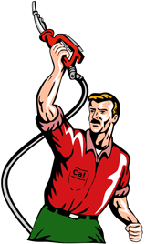 The human body, for all its wonderful complexity, is still a machine. It burns fuel (calories) to do work (moving and thinking). The fuel must be correctly formulated (nutritionally balanced), or the machine will run poorly. The mileage (calorie burn rate) depends on the year, make, and model (age, sex, and individual).
Unlike ordinary machines, however, your body can accept a huge surplus of fuel by converting it into fat.
All diets work by making your body burn off this fat reserve. To lose weight, you must expend more calories than you eat. There's no exception to this rule; it's a law of physics.
Diets differ only in how they tune the engine. Low-fat diets substitute a leaner fuel—mostly vegetables, fruits, and grains, which contain fewer calories than fatty foods. The Zone Diet makes the engine burn "hotter." (Exercise does the same thing.) A few diets (and most diet drugs) fool the machine into burning fuel wastefully or demanding less than it needs.
These are clever solutions. Yet most people who lose weight eventually regain it. Why?
 No diet can succeed if you shed pounds too fast. (Most experts recommend losing no more than two pounds a week). When you starve the engine of fuel, it responds by increasing its fuel efficiency. Suddenly, even skimpy meals feed your fat reserves. If you cut back even further, your body becomes even more efficient. Repeat the cycle and you become a "yo-yo dieter."
What you need is a "governor" that keeps the engine running at perfectly even efficiency. That's what DietPower is. It shows exactly how fast your body is using fuel, so you can eat the right amount to keep the fat reserve shrinking at a constant rate. By smoothing the fluctuations, it keeps you precisely on target.
 Your calorie needs aren't the only thing DietPower monitors. It watches your fuel mixture, too. Its Nutrient History button (left) reveals your consumption of 33 nutrients for the past week, month, quarter, and year:
|
|

 Susan uses her Nutrient History to help control her blood pressure. After lunch one afternoon, she clicks the Food Log button (far left) to record the meal, and discovers she's getting too little potassium today. To plan dinner, she clicks the Food Dictionary button (left) and searches 21,000 entries for items that are high in potassium but low in sodium. Voilà! The best choice is grilled salmon with a baked potato—and for dessert, fresh cantaloupe.
These nutrient-tracking features help in myriad ways:
 DietPower's Real-Time Eating Coach™ color-codes every item in the Food Dictionary. .Light green. foods help your Nutrition Quotient; gray foods hurt it. The colors are recalculated every time you log a food, so you always know which items are best to eat now. You can even see your "Smart Second"—the .bright green. food that will help you most if you double the amount already logged. The color-coding makes improving your nutrient balance a snap: just Eat Your .Greens.™.
 The button at left opens DietPower's 100,000-word Help system. Written by a top editor of Reader's Digest, it gives advice on what you're doing right now, instead of forcing you to search. It also offers animated tutorials.
The Help system includes articles covering everything from Alcohol to Zinc. Here's a taste:
…DietPower can instantly reveal the nutrients in any item in its 21,000-entry Food Dictionary—or in any recipe you create from them.
 To create a recipe, just click the Recipe Box button (left), drag and drop the ingredients, type in the directions, and give your concoction a name. You can print or email any recipe, complete with its nutrient analysis.
If you happen across a food that's not in DietPower's dictionary, you can add the food by entering nutrition facts from its label.
 …DietPower awards extra calories for exercise, which you record by clicking the Exercise Log button (left). The program knows the "burn rates" of nearly 1000 activities, and even factors them for your current body weight.
If your workouts slow your weight loss by increasing muscle mass, DietPower will lower your calorie budget to keep your weight on track.
Here's more that you can do with DietPower:
Anyone at least 14 years old, between four feet and seven feet tall, and weighing at least 75 but no more than 499 pounds.
Up to four different people on the same copy—provided all live year-round in the same household. (Larger groups can buy special editions. See "Prices," below.)
 Because DietPower runs on your hard drive, it works many times faster than it would on the Web. (In the split second that it takes to log each food, the program performs 10 million calculations.) You can still use the program on more than one computer, however. Click the Travel Bag button (left) to email your records to yourself or save them on a thumb drive.
Windows 10, 8, 7, Vista, XP, ME, or 2000 with at least 256 megabytes of RAM and one gigabyte of free disk space.
Although DietPower is a Windows program, you can run it on PC-emulator software such as Virtual PC. You can also ask us to email you if a Mac version becomes available.
DietPower is now free. You can download and install it from this website.